

Salary packaging calculator · 2026–27 tax rates
What does your salary package leave in your pocket?
Enter your package to see take-home pay and your super cap.
Take-home pay
Example$58,051.43a year
Example for $80,000 a year. Enter your package above.
Paid by your employer on top of this pay.
5-Year Carry-Forward
Total super balance under $500,000?
As at 30 June last year
If your total super balance was $500,000 or more on 30 June of the previous financial year, you cannot carry forward unused cap amounts.
NFP Salary Packaging
Do you work for a registered charity, PBI, or hospital?
PBI (Public Benevolent Institution), health charity, hospital or ambulance service
All calculators
Guides
 Take home payThe pay calculator, explained
 Pay cyclesAnnual salary to monthly pay
 Pay cyclesWeekly pay and tax
 Pay cyclesFortnightly pay and the monthly budget
 Hourly ratesHourly rate to salary
 Super and packagingThe July 2026 super changes
 Take home payHow to read a payslip
 Take home payDoes your state change your pay?
 Super and packagingHow a novated lease works
 Take home payMortgage offset accounts, explained
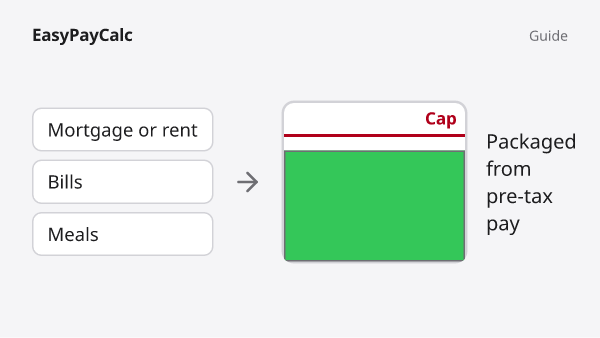
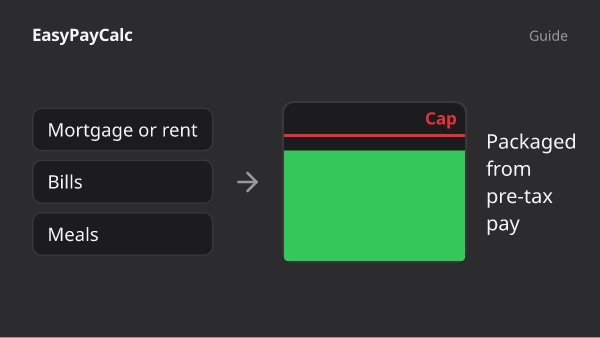 Super and packagingSalary packaging and the employer cap
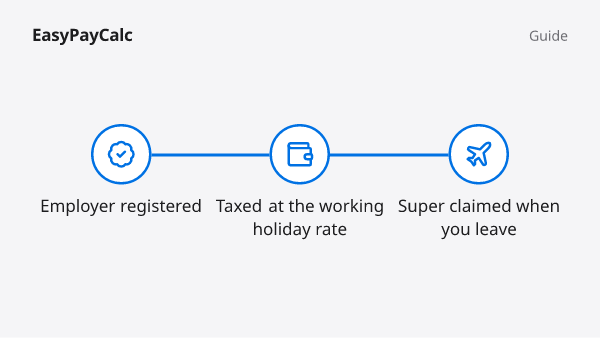
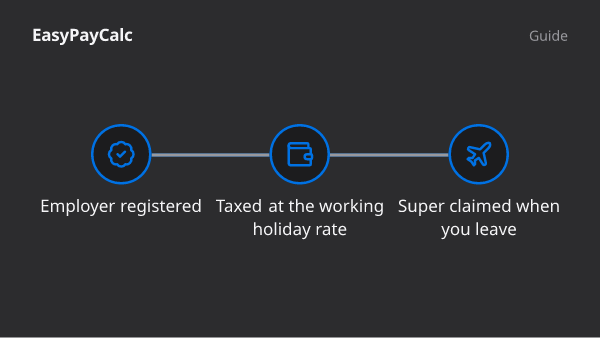 Take home payWorking holiday tax, start to finish
One name, two different sums
Salary sacrifice, salary packaging, total remuneration packaging. Three names, one idea, and nothing turns on which one your employer prints on the form. What the single name hides is that underneath it there are two arrangements, and they share almost nothing except the moment they happen: before tax is worked out.
One sends money to your super fund. The other buys things you would otherwise pay for from your take-home pay. Different rules, different limits, and a different party carrying the tax. Most confusion about packaging is really confusion about which of the two someone is talking about.
The first branch has a yearly allowance you can pass
Everything entering your super before tax shares one yearly allowance, and the calculator counts against it as you type. That is the whole of the first branch: one destination, one allowance, open to anyone whose employer runs payroll.
Passing the allowance does not stop you. The screen marks the point rather than refusing the number, because the point is where the concession ends, not where the arrangement becomes impossible. That distinction matters when you are deciding how much to put in: you are not looking for a barrier, you are looking for where the reason to do it runs out. Where that money goes afterwards, and what it costs to have it sitting out of reach until retirement, belongs to the guide to the July 2026 super changes.
The second branch is not yours to open
Take a benefit instead of salary and someone still owes tax on it. As a rule that someone is your employer, which is why most employers simply do not offer this branch. The exception is written into the law for a particular set of workplaces, and if yours is one of them, a slice of ordinary living costs can be paid from pre-tax salary.
So this branch turns on a question no other input on this screen asks. Everywhere else the calculator wants a number about you. Here it wants to know who employs you, and your own figures cannot answer that. Some employers also hand the arrangement to a provider to run. Which workplaces qualify, and what the cap counts, is set out in the salary packaging guide.
Two ceilings that never meet
Both branches have a yearly limit. The limits sound alike, sit in the same order of size, and are described with the same word, which is exactly why people reach for one figure and try to fit both branches inside it. They are separate schemes. Filling one to the top leaves the other untouched, and running out of room in one tells you nothing about the other.
There is a second trap inside the second limit. It is written on a grossed up basis, meaning the figure is scaled to what the benefit would have cost before tax rather than what you would hand over at the shop. The number you can actually spend is smaller, and that is why the screen shows the two versions side by side instead of printing one and hoping you know which it is.
The question to ask before the one about amounts
For most people only the first branch exists. That makes the opening move a question about your employer rather than about money: which branch is open to you at all. Nothing on this screen can answer it, and everything on this screen depends on it.
And you can safely ignore anything that treats the three names as three products. They are one idea wearing different labels, and an article that spends its length telling them apart has not got to the part that changes your answer.
Worked example: $10,000 sacrificed into super from $100,000
Take a $100,000 salary with the employer's super paid on top, and send $10,000 of it into super before tax during 2026–27. The person has no study loan and holds private hospital cover, which leaves two lines able to change: tax on income and the levy for Medicare.
- Salary before sacrificing$100,000.00
- Taxable income after the sacrifice$90,000.00
- Income tax and Medicare saved$3,200.00
- Contributions tax taken inside the fund-$1,500.00
- Net gain from sacrificing$1,700.00
- Take-home with no sacrifice$77,480.00
- Take-home after the sacrifice$70,680.00
Take-home drops by less than the amount sacrificed, and the tax saving makes up the difference. The money is still yours; it simply waits in super until the release rules let you reach it, which is the real price of the gain shown above.
| Sacrificed a year | Take-home a year | Going to super in total | Net gain after contributions tax |
|---|---|---|---|
| $2,500 | $75,780.00 | $14,500.00 | $425.00 |
| $5,000 | $74,080.00 | $17,000.00 | $850.00 |
| $10,000 | $70,680.00 | $22,000.00 | $1,700.00 |
| $15,000 | $67,280.00 | $27,000.00 | $2,550.00 |
Official guidance on packaging and the caps
- Salary sacrificing for employeesato.gov.au
What an effective arrangement looks like and which benefits can be packaged.
- Salary sacrificing superato.gov.au
How sacrificed amounts are taxed when they reach the fund, the line subtracted in the example.
- Contributions capsato.gov.au
The yearly concessional cap that employer super and the sacrifice together have to stay under. Every row of the table does.